

Introduction to RSI and Divergence
The Relative Strength Index (RSI) is one of the most widely used momentum oscillators in technical analysis, developed by J. Welles Wilder in 1978. It measures the speed and change of price movements on a scale from 0 to 100, typically using a 14-period setting. Readings above 70 indicate overbought conditions, while those below 30 suggest oversold territories. However, RSI's true power lies beyond simple overbought/oversold levels—it's in identifying divergences, which signal potential shifts in market momentum.
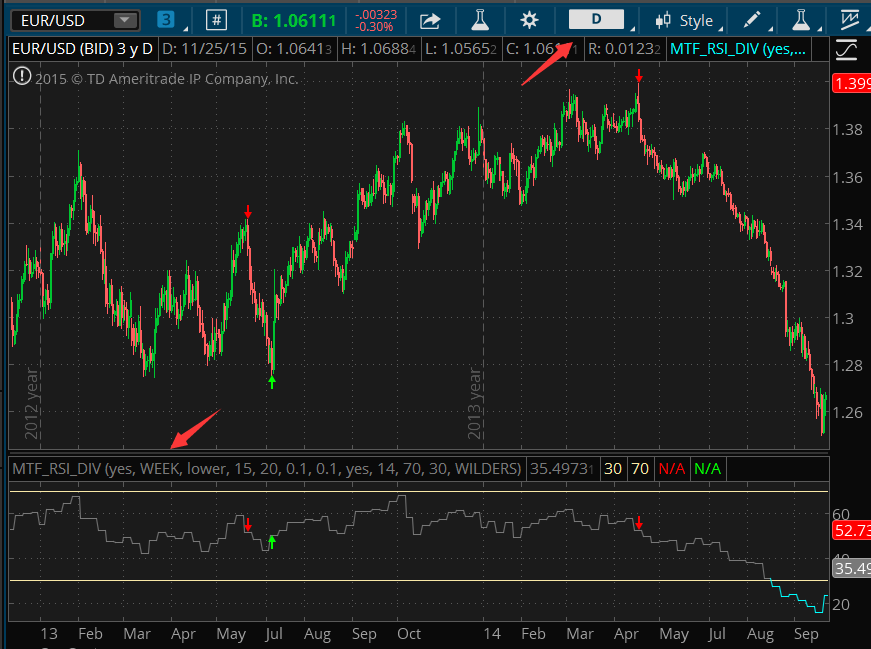
Divergence occurs when the price action and the RSI oscillator move in opposite directions, highlighting a weakening trend. There are two main types:
- Regular (Classic) Divergence: Often signals trend reversals.
- Bearish: Price makes a higher high, but RSI forms a lower high (momentum fading in an uptrend).
- Bullish: Price makes a lower low, but RSI forms a higher low (momentum building in a downtrend).
- Hidden Divergence: Typically indicates trend continuations.
- Bearish: Price makes a lower high, but RSI forms a higher high (continuation of downtrend).
- Bullish: Price makes a higher low, but RSI forms a lower low (continuation of uptrend).
While standard RSI divergence is effective, it can produce false signals in volatile markets or when confined to a single timeframe. This is where the Multi-Timeframe (MTF) RSI Divergence indicator shines, allowing traders to overlay divergence signals from higher timeframes onto their current chart for enhanced confirmation.
Overview of the MTF RSI Divergence Indicator
The MTF RSI Divergence indicator, available from PatternSmart, is designed for platforms like Thinkorswim (TOS), with adaptations for other systems such as NinjaTrader 8 in similar variants. It builds on the standard RSI divergence by incorporating multi-timeframe analysis, enabling traders to detect divergences from longer periods (e.g., hourly or daily) directly on shorter-term charts (e.g., 5-minute). Key highlights from its description include:
- No Lag or Repaint: Signals are generated in real-time at the current bar, ensuring reliability without hindsight bias.
- Detection of Both Regular and Hidden Divergences: It automatically identifies all four signal types (bullish/bearish regular and hidden) between price trends and RSI values.
- Customizable Plots: Features separate plots for each divergence type (e.g., Bullish Regular Signal, Bearish Regular Signal), which can integrate with scanners, watchlists, market analyzers, or automated strategies.
- Alert Functionality: Includes customizable alerts for new signals, helping traders stay informed without constant chart monitoring.
- Scan and Watchlist Integration: Compatible with platform tools for screening multiple assets or building divergence-based watchlists.
Parameters typically include:
- RSI Length: Default 14, adjustable for sensitivity (shorter for more signals, longer for fewer but stronger ones).
- Timeframe Selection: Choose the higher timeframe (e.g., 15-min, 30-min, 60-min, daily) to overlay on the base chart.
- Lookback Period: Defines how many bars back to check for swing highs/lows (e.g., 3-10 bars for accurate swing detection).
- Overbought/Oversold Thresholds: Custom levels (e.g., 70/30) to filter signals
This indicator is particularly suited for intraday and swing traders using futures, stocks, forex, or cryptocurrencies, as it leverages MTF to provide a broader market context.
How to Set Up and Use the MTF RSI Divergence Indicator
Setting up the indicator is straightforward on supported platforms like Thinkorswim:
- Installation:
- Download and import the indicator file into your platform (e.g., via Thinkorswim's "Studies" menu).
- Add it to your chart by selecting "MTF RSI Divergence" from the studies list.
- Configuration:
- Set the base RSI parameters (length, price source like close).
- Choose the MTF timeframe—e.g., apply a 60-minute divergence to a 5-minute chart for intraday trading.
- Enable alerts: Configure sound, email, or popup notifications for new divergences.
- Customize visuals: Adjust arrow sizes, colors, and whether to draw connecting lines between price and RSI peaks/troughs.
- Interpreting Signals:
- Bullish Regular Divergence: Look for a green upward arrow or 'B' label under a price low where RSI shows a higher low. This suggests a potential reversal from downtrend to uptrend—enter long positions after confirmation (e.g., price breaking above a recent high).
- Bearish Regular Divergence: Red downward arrow or 'S' above a price high with RSI lower high. Ideal for short entries in fading uptrends.
- Hidden Divergence: Use for trend continuation—e.g., bullish hidden (higher price low, lower RSI low) during pullbacks in uptrends to add to longs.
- MTF Overlay: On a 5-minute chart, a 30-minute divergence signal appears as a thicker line or distinct marker, indicating alignment with the larger trend. Only trade in the direction of the higher timeframe for higher probability.
- Practical Usage Strategies:
- Reversal Trading: Combine with support/resistance levels. For instance, a bullish regular divergence at a key support zone on the daily MTF could signal a strong buy.
- Trend Confirmation: In a strong uptrend, ignore bearish divergences unless confirmed by multiple timeframes; focus on bullish hidden for entries on dips.
- Scanning and Watchlists: Use the indicator's plots in a market scanner to filter stocks showing divergences across assets. For example, scan for bullish divergences on a watchlist of S&P 500 components.
- Risk Management: Always use stop-losses below recent lows for longs (or above highs for shorts). Target profits at prior resistance or using risk-reward ratios (e.g., 1:2).
- Confirmation with Other Tools: Pair with volume (increasing on reversal confirms signal), moving averages, or other oscillators like MACD for confluence.
Example: In a volatile stock like Tesla (TSLA) on a 15-minute chart, overlay a 1-hour MTF RSI Divergence. If price hits a new low but the 1-hour RSI shows a higher low (bullish regular), wait for a candle close above the divergence bar to enter long, targeting the next resistance.
Why the MTF RSI Divergence Indicator is Useful for Technical Analysis
In technical analysis, success hinges on identifying high-probability setups amid market noise. The MTF RSI Divergence indicator excels here for several reasons:
- Enhanced Signal Reliability Through MTF Confluence:
- Single-timeframe analysis often leads to whipsaws. By incorporating higher timeframes, the indicator filters out minor divergences, focusing on those with broader market agreement. This "top-down" approach aligns short-term trades with long-term trends, improving win rates.
- Early Warning of Momentum Shifts:
- Divergences often precede price reversals by several bars, giving traders an edge. The real-time, non-repainting nature ensures signals are actionable without delay, crucial in fast-moving markets like forex or futures.
- Versatility Across Market Conditions:
- Works in trending or ranging markets: Regular divergences for reversals in ranges, hidden for continuations in trends. Its integration with scans and strategies makes it ideal for algorithmic trading or high-volume screening.
- Reduces Emotional Bias:
- Objective signals based on mathematical discrepancies eliminate guesswork. Alerts prevent missed opportunities, while customizable parameters allow adaptation to personal trading styles.
- Backtesting and Strategy Building:
- Plots compatible with backtesters (e.g., Strategy Builder) enable quantitative validation. Studies show divergence strategies can yield positive expectancy when combined with MTF, especially in equities and indices.
Empirical evidence from trading communities (e.g., forums ) highlights its utility: Users report fewer false signals compared to standard RSI, with MTF adding a layer of confirmation that boosts confidence.
Potential Limitations and Best Practices
While powerful, no indicator is infallible. Divergences can fail in strong trends (e.g., "divergence traps" where momentum rebuilds), so always confirm with price action. Over-optimization of parameters can lead to curve-fitting—test on out-of-sample data. In low-volatility markets, signals may be sparse.
Best practices: Use on liquid assets, combine with fundamental analysis for context, and maintain a trading journal to refine usage.
Conclusion
The MTF RSI Divergence indicator from PatternSmart is a must-have for technical analysts seeking to elevate their game. By merging the proven RSI divergence concept with multi-timeframe insights, it provides a comprehensive view of momentum dynamics, helping traders spot reversals, continuations, and high-probability entries. Whether you're a day trader scanning for intraday setups or a swing trader aligning with daily trends, this tool's real-time accuracy, customization, and integration capabilities make it invaluable. Incorporate it into your arsenal, and watch how it transforms your analysis from reactive to proactive in the ever-evolving markets of 2026 and beyond.
Get it now: MTF(Multi Time Frame) RSI Divergence indicator, scan, watchlist(custom quotes) for Thinkorswim TOS

No comments:
Post a Comment