

Introduction
In the world of technical analysis, traders and analysts rely on a variety of indicators to decipher market trends, identify support and resistance levels, and gauge potential overbought or oversold conditions. One such tool that has gained attention for its simplicity and reliability is the True Center Band (TCB) indicator. Originally developed for platforms like NinjaTrader, MultiCharts, and others, TCB offers a unique approach to visualizing price action by focusing on the "true center" of price movements within a specified period. This article delves into how to use the TCB indicator, its underlying mechanics, and why it stands out as a valuable asset in a trader's toolkit.
Unlike more complex indicators that may repaint or require extensive parameter tweaking, TCB emphasizes responsiveness and accuracy, making it suitable for both novice and experienced traders across various markets, including stocks, futures, forex, options, and ETFs.
What is the True Center Band (TCB) Indicator?
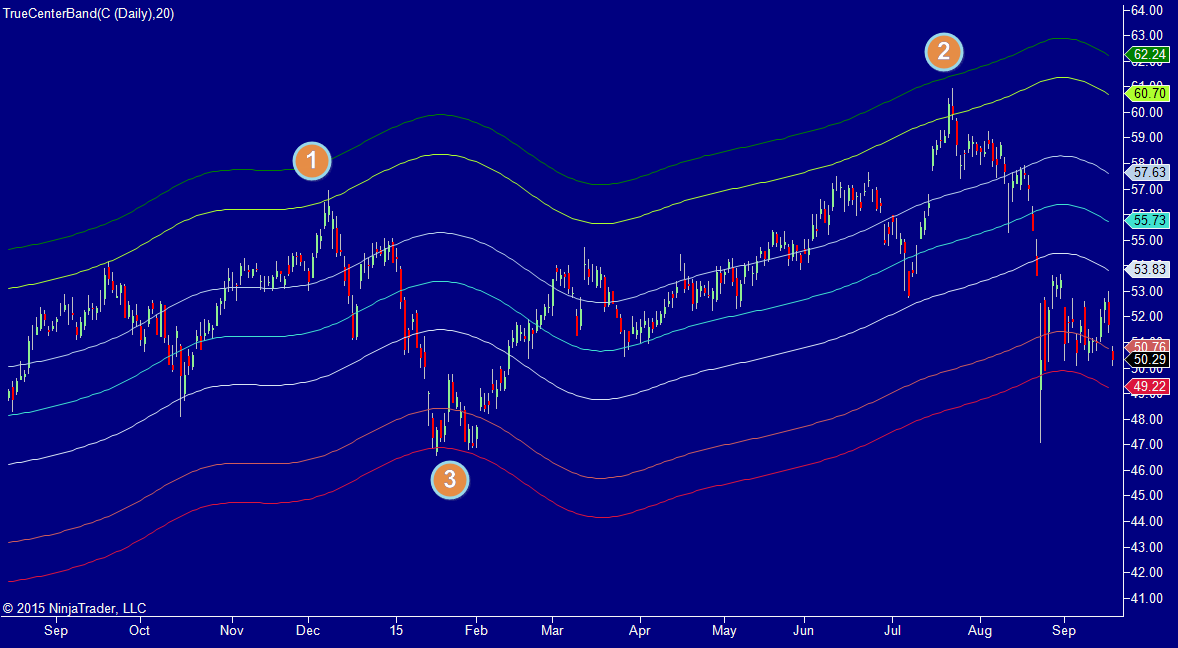
The True Center Band (TCB) is a custom technical indicator designed to plot a center line that represents the midpoint of the price range over a given number of bars, surrounded by multiple bands that act as dynamic support and resistance levels. Typically, it features one central line and three to four channels (bands) above and below it, depending on the version and platform. These bands help delineate the boundaries of price action, providing insights into trend direction, potential reversal points, and market volatility.
A key distinguishing feature of TCB is its non-repainting nature—it calculates values based solely on historical data without incorporating future prices, ensuring that once a signal is generated, it remains consistent. This reliability sets it apart from indicators like the Polynomial Regression Channel (PRC), which may adjust retrospectively and lead to misleading backtests.
TCB is versatile, functioning effectively on intraday charts (such as tick, minute, renko, or range bars) as well as daily charts. Its adaptive design allows it to automatically adjust based on the data loaded, making it responsive to different timeframes and market conditions.
How the TCB Indicator Works
At its core, TCB calculates the center line by determining the average or midpoint of the high-low price range over a user-defined period of bars. This center line serves as a baseline for trend analysis: prices above it may indicate bullish momentum, while those below suggest bearish tendencies.
Surrounding the center line are the bands, which expand or contract based on the volatility and price range of the loaded data. For instance:
- The uppermost band (often colored dark green) can signal overbought conditions when prices approach or touch it.
- The lowermost band (typically red) indicates oversold territories.
- Intermediate bands provide additional layers of support and resistance, helping traders identify potential pullback zones or breakout opportunities.
The indicator's responsiveness comes from its dependency on the total number of bars or days loaded in the chart. Loading more data (e.g., 50 days instead of 5) results in wider bands, reflecting a broader historical price range and thus longer-term support/resistance levels. This automatic adjustment eliminates the need for manual recalibration, though it requires careful chart setup to avoid unintended results.
Unlike static indicators, TCB dynamically adapts, making it ideal for capturing both short-term fluctuations and long-term trends without repainting historical plots.
Parameters and Setup
Setting up TCB is straightforward, but attention to parameters is crucial for optimal performance. The primary adjustable parameter is:
- Period: This defines the number of bars used in the calculation. A higher value (e.g., 50) smooths the indicator for long-term trend analysis, while a lower value (e.g., 15) makes it more sensitive to short-term movements.
Additionally, platform-specific settings influence TCB:
- Days to Load (in NinjaTrader or similar): This chart property determines the historical data scope. For example, on a 60-minute chart, setting it to 5 days might yield tighter bands, while 20 days produce wider ones, altering support/resistance plots even with the same period.
To set up:
- Add TCB to your chart via your trading platform (e.g., NinjaTrader, MultiCharts).
- Adjust the Period based on your trading horizon.
- Configure "Days to Load" in chart settings to match the desired analysis range—use higher values for broader market context.
- Test on historical data to ensure bands align with key price levels.
Tip: Always verify setup on a demo account, as mismatched "Days to Load" can lead to varying band positions on the same timeframe.
How to Use TCB in Trading
TCB's versatility allows for multiple applications in technical analysis:
- Trend Identification: The center line acts as a dynamic moving average. Crossovers above the line can signal uptrends, while breakdowns below indicate downtrends. Combine with price action for confirmation.
- Support and Resistance Trading: Use the bands as key levels. For instance, buy near lower bands in an uptrend (support) or sell near upper bands in a downtrend (resistance). Breakouts beyond the outer bands may signal strong momentum shifts.
- Overbought/Oversold Signals: Prices touching the top band suggest overbought conditions, potentially warranting short positions or profit-taking. Conversely, the bottom band highlights oversold opportunities for longs.
- Volatility Assessment: Band width reflects market volatility—widening bands indicate increasing volatility (potential for breakouts), while contracting bands suggest consolidation.
- Multi-Timeframe Analysis: Apply TCB on higher timeframes for overall trend direction, then switch to lower ones for entry timing.
Always integrate TCB with other tools like volume indicators or candlestick patterns for robust strategies. For example, a bullish engulfing candle at the lower band could be a strong buy signal.

Why TCB is Useful for Technical Analysis
TCB's utility stems from its ability to consolidate multiple analytical functions into one indicator, reducing chart clutter and decision-making complexity. Here's why it's particularly beneficial:
- Reliability and Non-Repainting: In volatile markets, repainting indicators can erode trust. TCB's forward-compatible calculations provide consistent signals, aiding in accurate backtesting and live trading.
- Adaptability: Its automatic adjustment to loaded data makes it suitable for dynamic markets, where fixed-period indicators might fail. This responsiveness helps capture evolving trends without constant reconfiguration.
- Simplification of Complex Analysis: By plotting trends, S/R, and boundaries simultaneously, TCB streamlines workflows, especially for intraday traders dealing with fast-moving charts.
- Broad Applicability: Works across all asset classes and chart types, making it a go-to for diversified portfolios.
Compared to traditional bands like Bollinger Bands, TCB focuses more on price centering and multi-level S/R, offering nuanced insights without standard deviation complexities. Users report it "looks good and works better," enhancing visual and practical trading experiences.
Real-World Examples
Consider a 30-minute forex chart (e.g., EUR/USD) with TCB set to a Period of 20 and 10 days loaded:
- During a ranging market, prices oscillate between the inner bands, signaling consolidation. A breakout above the upper band could prompt a long entry.
- In a trending scenario, the center line acts as dynamic support; repeated bounces off it confirm the uptrend.
Another example: On a daily stock chart with 50 days loaded, wider bands highlight long-term S/R. If prices approach the red lower band amid positive news, it might indicate an oversold buying opportunity.
Videos and comparisons (e.g., vs. PRC) demonstrate TCB's stability, where it maintains plots while others repaint.

Conclusion
The True Center Band (TCB) indicator is a powerful, user-friendly tool that enhances technical analysis by providing clear, reliable insights into trends, support/resistance, and market conditions. Its non-repainting design, adaptability, and broad compatibility make it an essential addition for traders seeking efficiency and accuracy. By mastering its setup and applications, you can elevate your trading strategy, turning complex price data into actionable opportunities. As with any indicator, combine TCB with risk management and continuous learning for the best results.

No comments:
Post a Comment