

Case Study: Capturing Short-Term Resistance in a Strong Uptrend with DynamicSupplyDemandZone
In this example, the market is moving within a clear upward trend. Price continues to form higher highs and higher lows, while demand zones repeatedly act as support during pullbacks. Under this type of market condition, traders often need to identify short-term resistance quickly, because countertrend supply areas may appear briefly before price either reacts or continues higher.
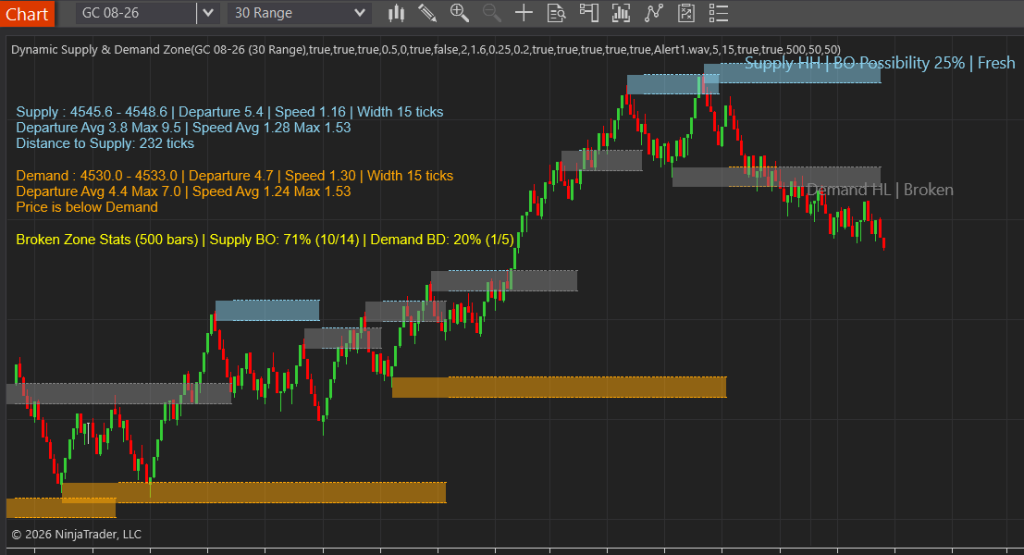
Using DynamicSupplyDemandZone, the indicator settings can be adjusted to better match this environment.
For a strong uptrend, a smaller value can be used for Strength for Supply. This makes the indicator more sensitive when detecting potential supply zones. As a result, short-term resistance areas can be identified earlier, even if the supply structure is relatively small or temporary.
At the same time, a relatively larger value can be used for Strength for Demand. This helps filter out weaker demand areas and focuses more attention on stronger support zones that are more relevant within the dominant bullish trend.
In the chart, the market advances strongly before forming several short-term supply zones near the upper price area. These supply zones provide traders with a faster visual reference for possible intraday resistance. Instead of waiting for a larger reversal structure to develop, traders can use these zones to monitor where price may pause, reject, or pull back.
The demand zones below price remain important because they represent areas where buyers previously stepped in. With a higher demand strength setting, the indicator highlights more meaningful support zones rather than every minor pullback. This creates a cleaner chart and helps traders stay aligned with the broader uptrend.
This approach is especially useful for short-term traders who want to:
Identify potential resistance earlier during a strong rally.
Avoid overreacting to weak demand zones in an uptrend.
Use supply zones as reference areas for profit-taking, pullback monitoring, or trade management.
Maintain focus on the dominant bullish structure while still tracking short-term selling pressure.
Overall, this case shows how DynamicSupplyDemandZone can be adapted to different market conditions. In a clearly rising market, using a lower Strength for Supply and a higher Strength for Demand allows traders to detect short-term resistance more quickly while keeping the main support structure cleaner and more reliable.

No comments:
Post a Comment